Guide · 17 August 2026 · 8 min read
Km 0 food: what the Italian label means, and what it does not
Part of the guide: Buying food direct from farms: the complete guide
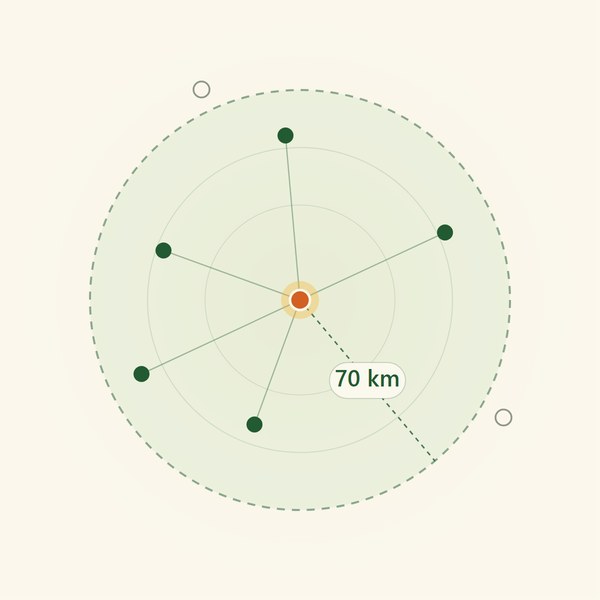
"A km 0" is one of those labels that looks obvious on a shelf ticket and stops being obvious the moment you think about it. In Italy it is no longer a marketing phrase: since June 2022 a national law says how many kilometres it means, who may print it, and what it costs to print it without the right. This guide sets out the definition, how km 0 differs from a short supply chain, which of its advantages survive scrutiny, and how to buy that way without living in the countryside.
The same thing is written three ways on a shelf ticket — "km 0", "km zero", and "agricoltura a km 0" when the subject is the way of farming rather than one product. They mean the same thing: the law fixes the distance, not the spelling.
What does km 0 actually mean in law?
Law 61 of 17 May 2022, in force since 26 June 2022, calls a food product "a chilometro zero" when the place it was produced — and the place its agricultural raw materials were processed — lies within a radius of 70 km of the point of sale, or at least within the same province. For fish, the reference point is where the catch was landed.
Two details do most of the work here. The 70 km are measured from the shop, not from your kitchen: the same jar of honey is km 0 in one shop and not in another an hour up the road. And processing counts alongside growing, so jam cooked 300 km away from local fruit does not qualify.
Is km 0 the same as a short supply chain?
No, and the law keeps the two apart on purpose, because they measure different things. Km 0 measures a distance. A short supply chain — filiera corta — measures how many hands the food passes through: it covers products with no commercial intermediary between the producer and the final buyer, or at most one. Cooperatives and their consortia are not counted as an intermediary.
The two labels overlap far less neatly than people assume. A cheese bought at the dairy 5 km away is both. The same cheese sent directly to you 400 km away is a short chain but not km 0. A local product that has been through two wholesalers travelled 10 km and is neither. If what you care about is dealing with the people who made the food, short supply chain is the phrase to follow — our guide to buying direct from farms covers how that works end to end.
Who checks that km 0 is true?
The law hands the official km 0 and short-chain logos to a ministerial decree, along with the rules for granting them: the conditions, the check on territorial provenance, the traceability. One choice in it is worth noticing — the logo does not go on the packaging. It is shown where the sale happens: in the shop, on the online platform, in the restaurant serving the dish. The reasoning is practical. Km 0 is not a property of the food itself; it is a relationship between the food and the place you are buying it, and packaging travels.
Until that logo is in common use there is a voluntary reference standard, UNI/PdR 127:2022, which sets requirements for declaring a product km 0 and can be displayed at the point of sale. On the market side, the law reserves at least 30% of the space in farmers' markets for short-chain products, and provides fines of €1,600 to €9,500 for using either wording without being entitled to it. If you are on the other side of that counter, selling your own food direct is a separate subject with its own list of conditions: what direct sale actually requires of a producer.
What are the real advantages of buying at km 0?
Fewer days between harvest and table. Distance is time, and time is the one thing that cannot be added back to a leaf, an egg or a fish. Food that does not have to survive a journey can be picked ripe rather than picked early, which is where most of the taste difference actually comes from.
You can go and look. A producer 70 km away is close enough to visit, to phone, to see at a market. That is a weaker guarantee than a certificate on paper and a much stronger one in practice, because it is the only kind that a farm cannot renew by paperwork alone.
More of the price stays with the person who grew it. Short distance usually goes with few intermediaries, and each one removed is a share of the price that stays on the farm — which is what decides whether that farm is still there in five years.
And the disadvantages nobody prints on the sign?
Km 0 is not automatically greener. For most foods, transport is a small part of the total footprint next to how the food was produced: a vegetable grown out of season in a heated greenhouse nearby can cost more carbon than the same vegetable grown in the open field far away and shipped. Season and method usually matter more than distance.
It is not a quality mark and not organic. The law measures geography, nothing else. A mediocre product made 20 km away is still km 0; an excellent organic one made 90 km away is not.
It is not automatically cheaper. Small-scale production costs more per kilo than industrial production, and a short chain does not always cancel that out. Where it does pay off is over a week, in what you throw away rather than in what you pay at checkout.
The choice narrows. Measured from a shop in the middle of a city, a 70 km radius can be a thin list in February. This is where honest shopping means buying what is in season rather than expecting a complete range all year.
How do you buy at km 0 without living in the countryside?
Start from the producer rather than from the label. On GetEats every product belongs to a named farm with its own storefront and its own location, so the distance question has an answer before you order rather than after. You can browse producers by area on the farm map, and each storefront tells you who is behind it and where they are.
Two honest caveats. Not everything you can order here is km 0 in the legal sense — that depends on where you are, and a marketplace that claimed otherwise would be doing exactly what the law was written to stop. And we are a short chain by construction: your order goes to the farm that made the food, which packs and sends its own part of it.
So the practical version is simple. Check where the producer is, buy what the season is actually offering, and keep the basket concentrated on one or two farms rather than eight — delivery is worked out per producer, so a focused order usually travels better and cheaper. Browse what is available near you and judge the distance for yourself.
And if it is a producer reading this page — it happens; distance is an argument that interests both sides of the counter — the page for producers explains the same thing from the other side: who prepares the storefront, who sets the prices, what it costs, and what happens to an order from the moment it arrives.
Frequently asked questions
How many kilometres is km 0, exactly?
Under Italian law it is a radius of 70 km between the place of production and the point of sale, or the same province. It is measured from the shop or platform selling the food, not from the buyer's home.
Does km 0 mean the product is organic?
No. The rule measures geography and nothing else, so a product made 20 km away is km 0 whether or not it is certified organic, and an organic product made 90 km away is simply not km 0.
Is food at km 0 always better for the climate?
Not always. For most foods the way they were produced weighs more than how far they travelled, so a vegetable grown out of season in a heated greenhouse nearby can carry a heavier footprint than a field-grown one from further away.
Can you buy km 0 products online?
Yes, and the law anticipates it: the official logo is displayed where the sale happens, including on an online platform. Because distance is what defines the claim, check where the producer actually is before ordering.
What happens to a seller who writes km 0 without being entitled to?
The law provides fines of €1,600 to €9,500 for using either the km 0 or the short supply chain wording without meeting the conditions, which is what turned both phrases from marketing into regulated claims.
"Km zero" and "km 0" — are they the same thing?
Yes. The law fixes the distance, not the spelling: "km 0", "km zero" and "agricoltura a km 0" all point at the same limit of 70 kilometres, or the same province. A different wording on the ticket does not change the rule behind it.